
With the rapid penetration of distributed PV systems, the challenges facing distribution networks are no longer limited to slight voltage fluctuations. A more practical and pressing issue is emerging: severe three-phase imbalance is becoming a key risk to the safe and stable operation of distribution transformers and low-voltage distribution networks.

As more distributed PV systems are connected through single-phase access, EV charging stations are deployed at scale, and residential loads naturally exhibit phase imbalance, three-phase imbalance in distribution networks is becoming increasingly common.
This can lead to a series of serious problems:
Excessive neutral current may cause cable overheating and even transformer failure in severe cases.
Long-term unbalanced operation increases transformer losses, shortens service life, and may eventually result in overload tripping.
Phase voltages deviate from their rated values, affecting the normal operation of electrical equipment and reducing power quality.
Voltage, current, and other electrical parameters frequently exceed allowable limits, compromising grid stability.

Rather than relying on theoretical analysis, we let real test data provide the answer.
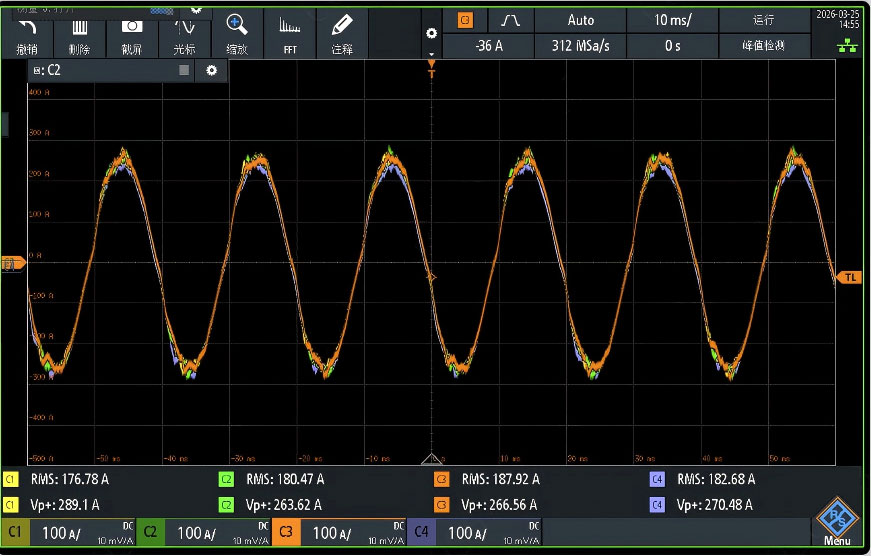
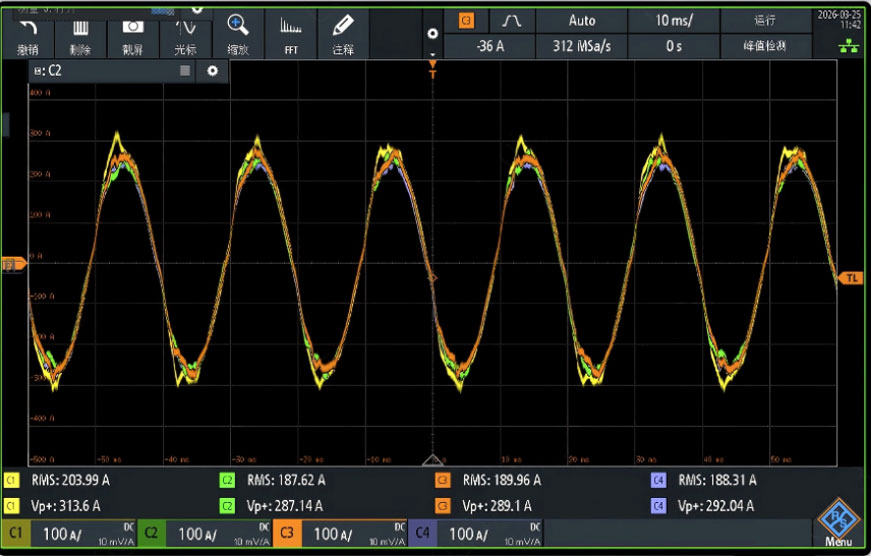
To verify the product's ultimate performance under extreme operating conditions, we simulated an exceptionally demanding scenario: eight PCS modules operating in parallel, with Phase A carrying a full load of 41.5 kW × 8 units, while Phases B and C carried no load at all.This "one phase fully loaded, two phases completely unloaded" condition represents one of the most challenging scenarios for three-phase imbalance compensation.
The measured results are shown below:
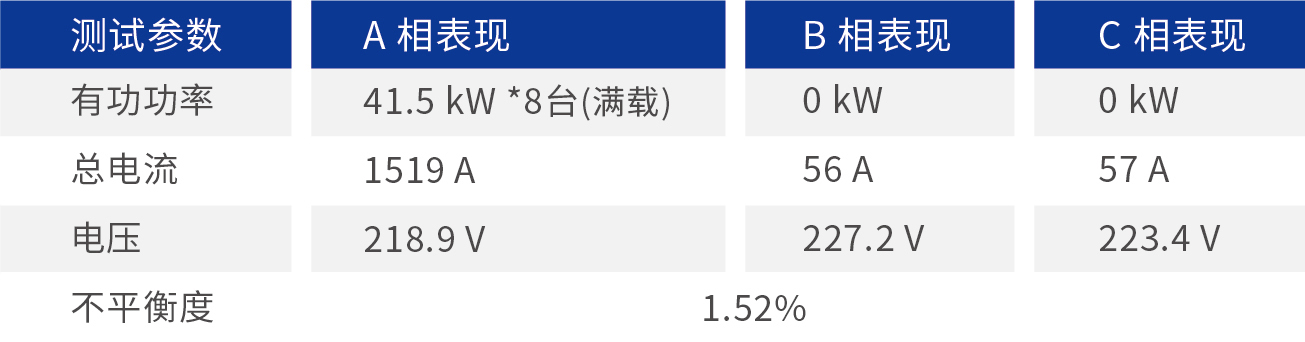
*According to GB/T 15543 "Power Quality – Three-Phase Voltage Unbalance," the allowable voltage unbalance at the point of common coupling (PCC) under normal operating conditions is 2%, and shall not exceed 4% for short durations.
This means that even under extreme single-phase loading conditions, the system can actively regulate and achieve 100% three-phase imbalance compensation.
More importantly, this capability remains effective when eight PCS units operate in parallel. This demonstrates not only outstanding balancing performance at the individual unit level, but also excellent scalability at the system level.

Why can Topology Electric Power achieve such exceptional compensation performance with a three-leg topology architecture? The answer lies in our unique underlying system design.
Traditional four-leg topologies achieve neutral-point control by adding an additional bridge leg. While this enables 100% three-phase imbalance compensation, it comes with higher hardware costs. Conventional three-leg topologies, on the other hand, are inherently limited by their architecture and cannot completely eliminate imbalance issues. Drawing on years of expertise in power electronics hardware and software development, Topology Electric Power has innovatively developed a "Three-Leg Topology + Balancing Circuit" architecture.Its advantages can be summarized in three core capabilities:
The PCS supports independent control of all three phases, allowing one phase to charge (absorbing excess PV energy) while another phase simultaneously discharges (supporting loads), thereby compensating imbalance currents in real time. The system can adapt to any heavily loaded phase as well as any lightly loaded or unloaded phase, ensuring that performance is not restricted by load distribution.
The three-leg topology reduces the number of power devices, lowering system complexity, improving reliability, and reducing overall costs. Combined with an efficient balancing circuit, the system can more flexibly manage energy flow between the neutral conductor and phase conductors, delivering superior balancing performance.
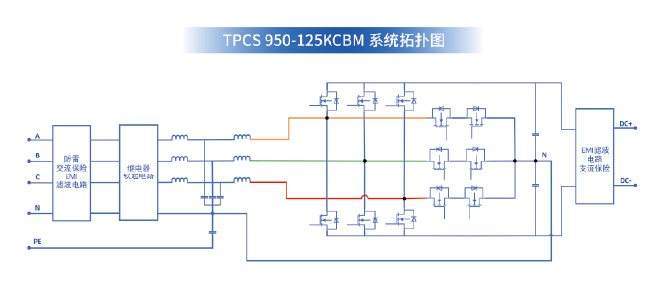
Advanced control algorithms continuously calculate imbalance levels and dynamically drive the balancing circuit for real-time compensation. Whether facing instantaneous load impacts or prolonged severe imbalance conditions, the system can respond within milliseconds, ensuring stable grid operation at all times.
No Compromise. Only Excellence.
Power quality management should not be about temporary fixes—it should be about fundamentally redefining system performance.
When it comes to three-phase imbalance compensation, Topology Electric Power's answer is clear:No compromise. Achieve 100% compensation.
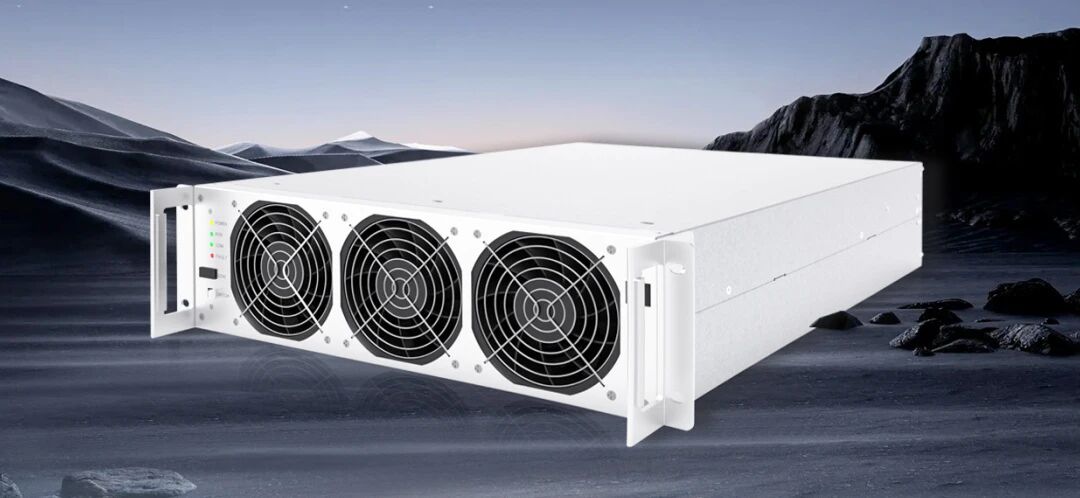
Our solutions are now fully available to the market, helping more distribution networks achieve intelligent, stable, and efficient energy management. If you are facing challenges such as three-phase imbalance, voltage fluctuations, or other power quality issues, feel free to contact us. Topology Electric Power is ready to provide professional and customized solutions tailored to your specific application needs.

